Suppose we are given a square lattice. A dimer model over this lattice corresponds to a subset of its edges that form a perfect matching. The Aztec diamond of size \(n\) is a diamond-shaped subgraph of the square lattice that consists of \(2n(n+1)\) vertices. A dimer model over the Aztec diamond is equivalent to a tiling of a diamond composed of squares with \(2\times 1\) dominoes. The following figure displays an example of such a tiling.
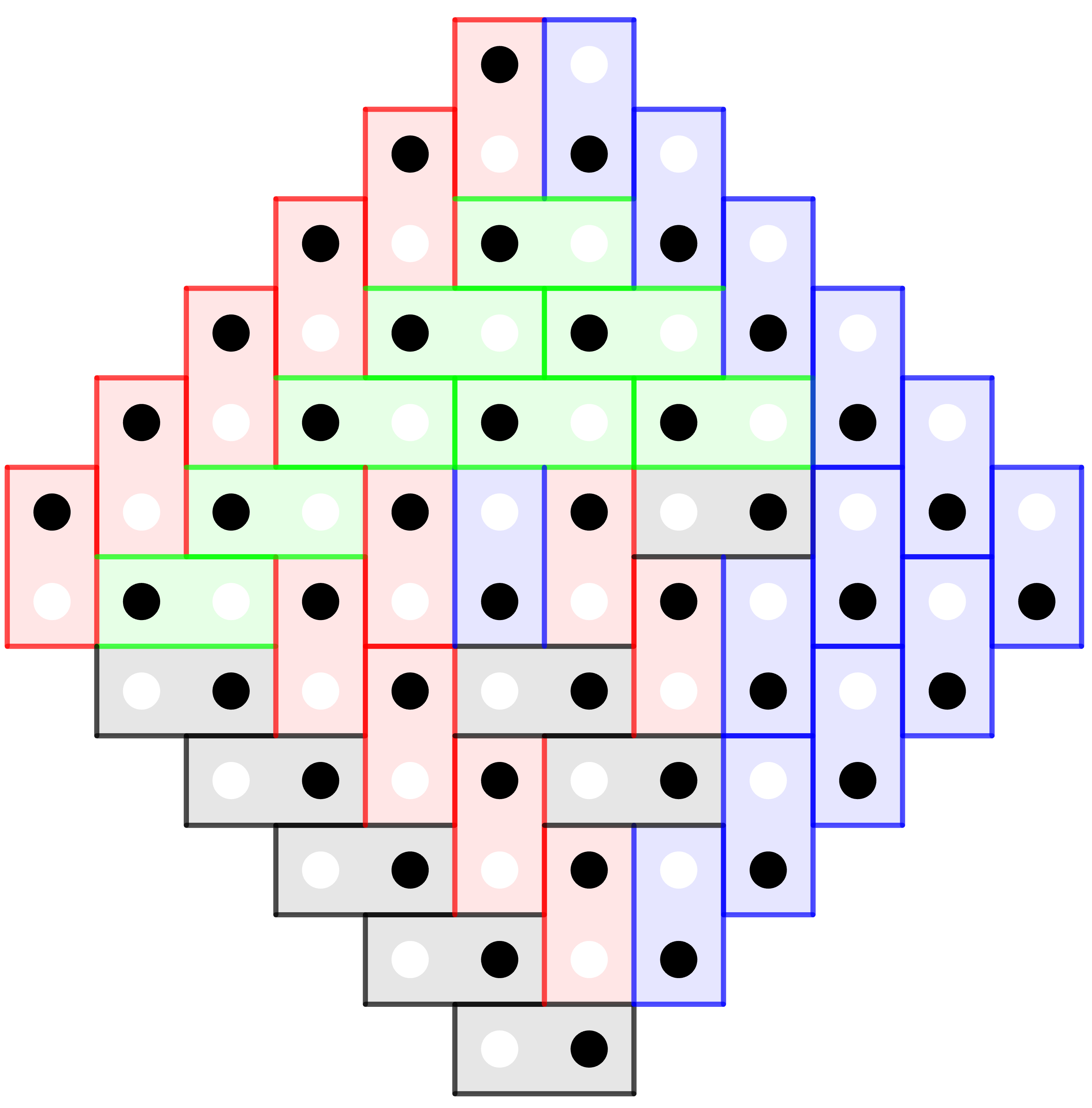
The paper [1] shows that the number of tilings of the Aztec diamond is \(2^{\frac{n(n+1)}{2}}\). In some cases, there is a bijection between weighted domino tilings of a collection of squares and non-intersecting paths between points on the collection's boundary. This bijection and a mapping from each set of non-intersecting paths to an instance of the six-vertex model with domain wall boundary conditions at its free fermion point is explained in [2]. We exhibit an example of the bijection in the following figure, where the domino tiling is that of Figure 1.
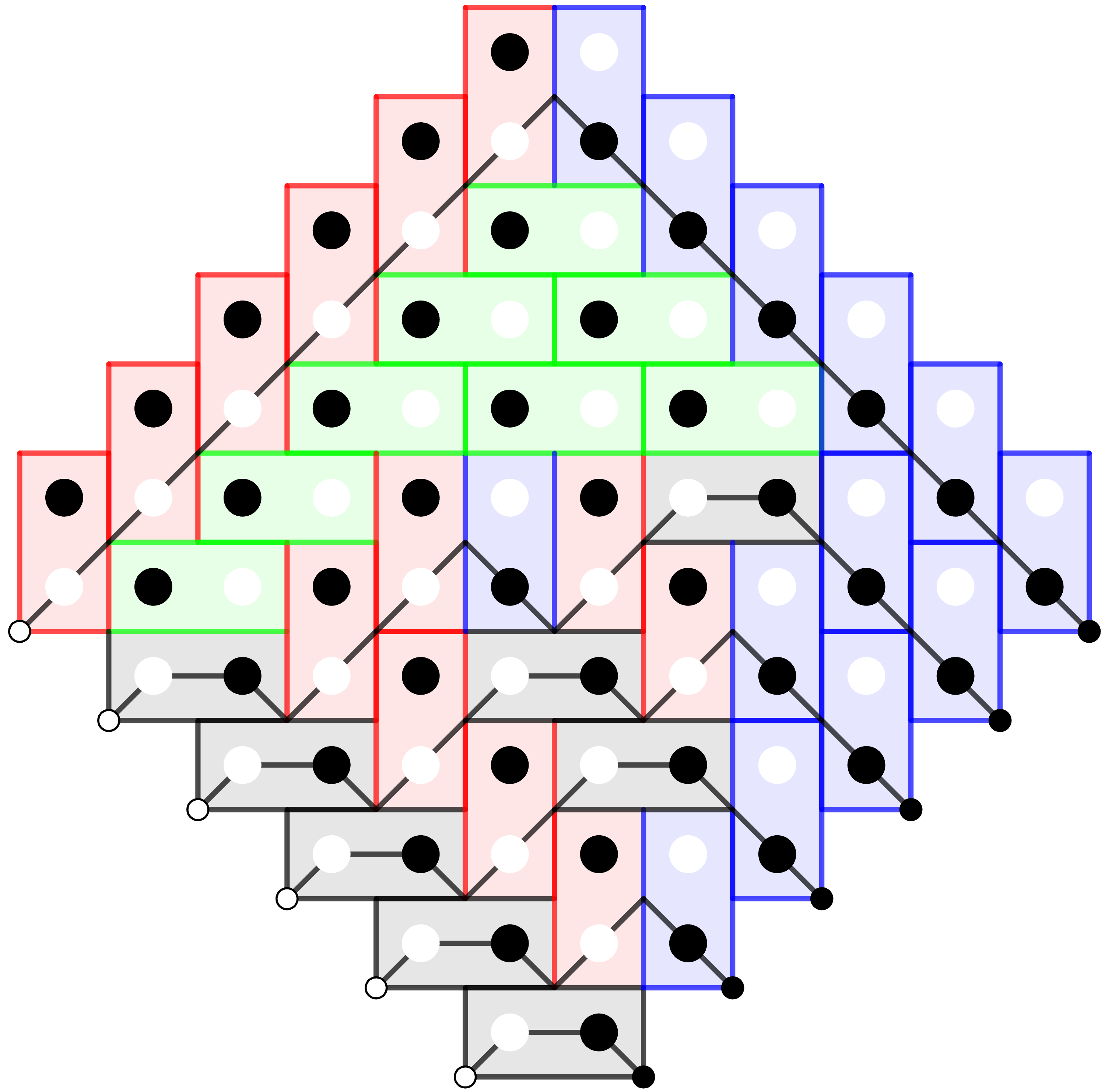
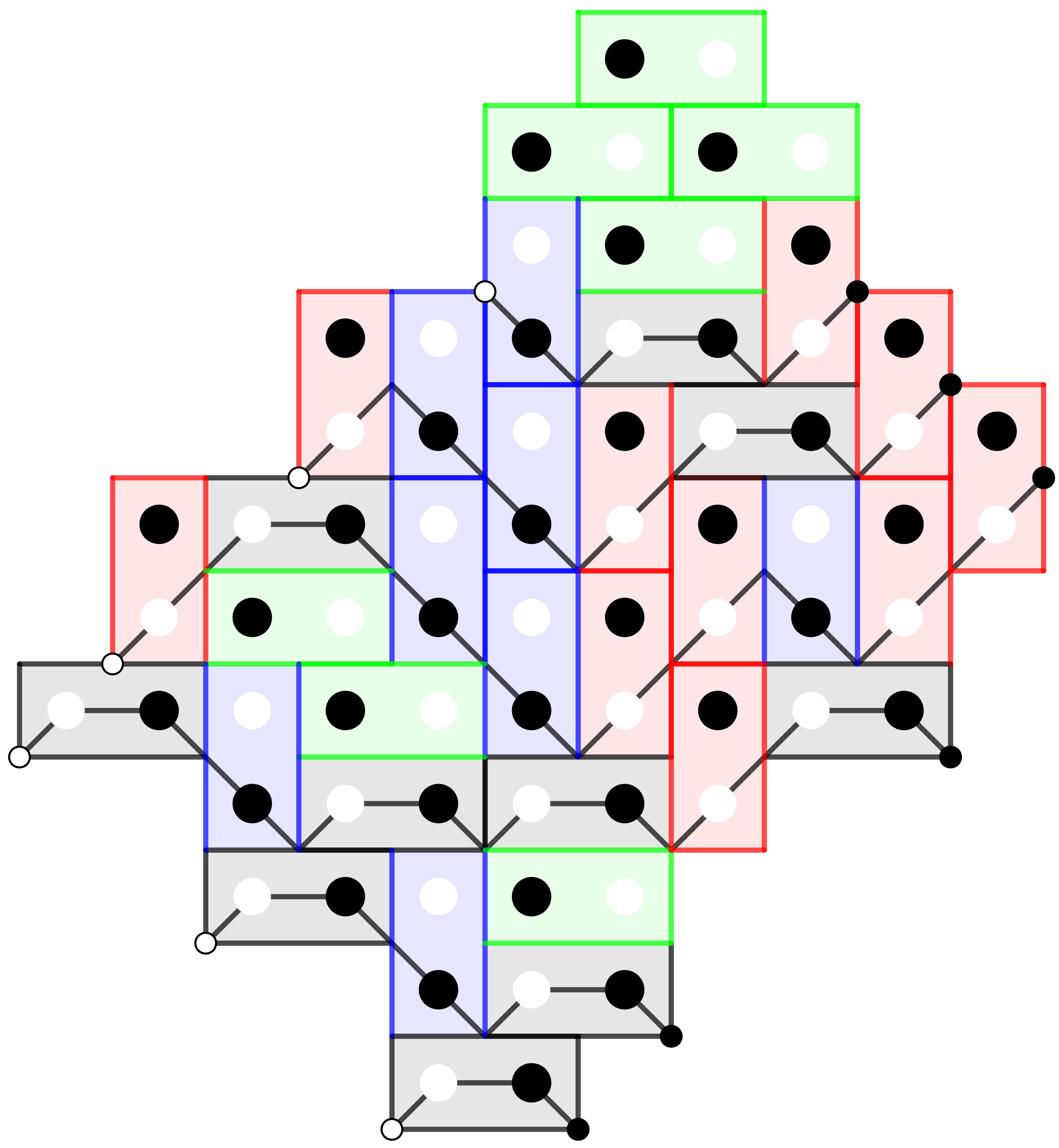
In the bijection, each of the four classes of dominoes corresponds to a fixed component of a path, see Figure 2. Moreover, the shape of the collection of squares does not need to be a diamond, as illustrated in the following example.
We study domino tilings of a shape by scaling the shape and considering the statistics of the tilings as the scaling parameter increases to \(\infty\). To examine the asymptotics of tilings of the Aztec diamond and more generally of the Aztec rectangle, we can construct a bijection between weighted tilings and the Schur process. This bijection is based on the Pieri formula and branching rule for Schur functions. See Figure 4 for a visualization of the branching rule. The method of first computing a Schur generating function, which is a weighted average of Schur functions, and then applying the bijection to analyze the statistics of unweighted or weighted tilings is used to study the asymptotic fluctuations of tilings in [3], [4], [5], and [6]. These works verify special cases of the Kenyon-Okounkov conjecture, which states that the fluctuations of dimer models over general lattices and shapes should converge to the Gaussian free field, see [7]. Some additional special cases of this conjecture for the square lattice are verified in [8] and [9].
We can analogously consider the dimer model over a hexagonal lattice rather than a square lattice. This corresponds to tiling a triangular grid with lozenges, which are diamonds that may have three orientations. We exhibit an example of a lozenge tiling of a hexagon in the following figure.
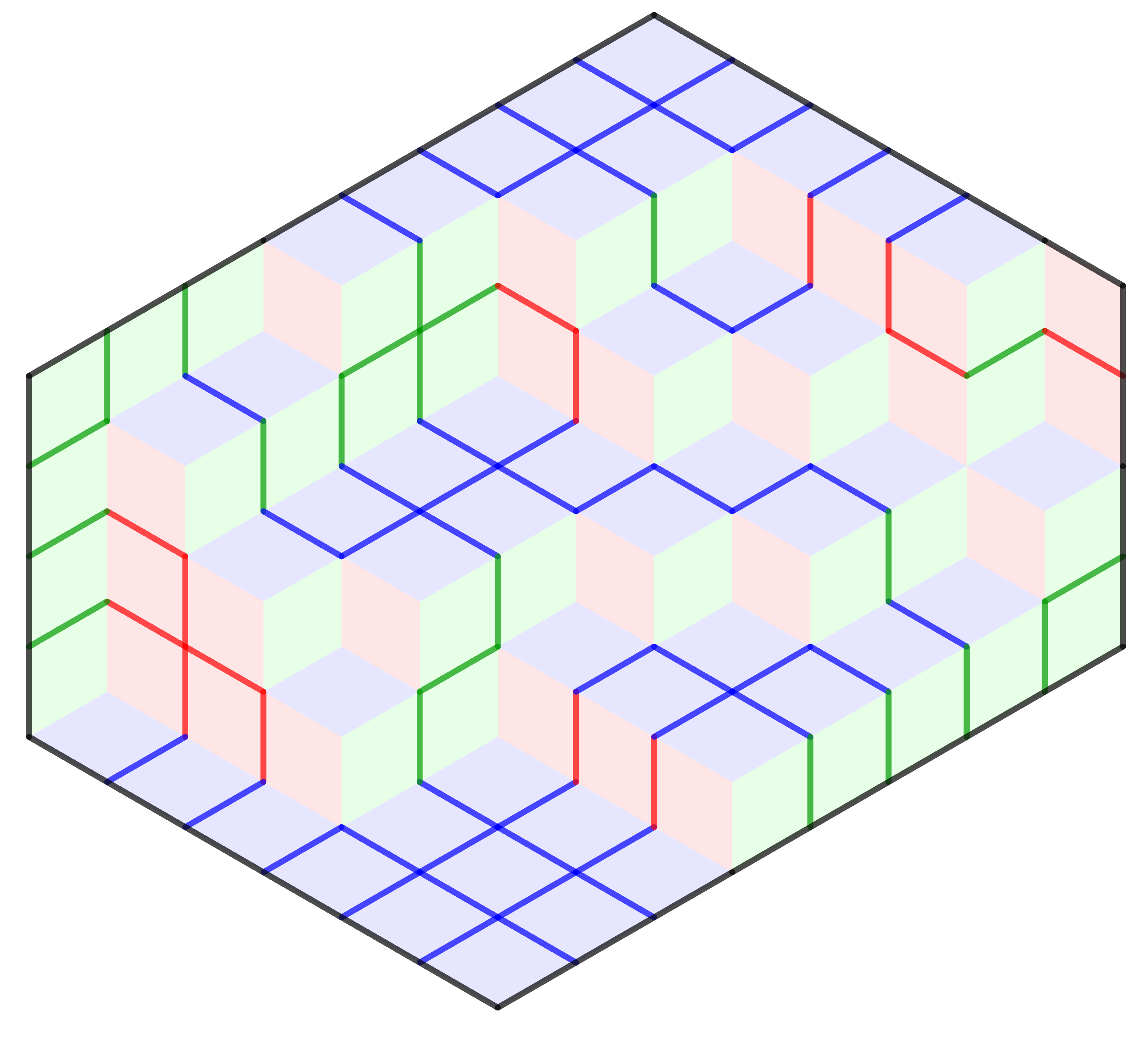
We can similarly construct a bijection between lozenge tilings and the Schur process. This bijection is based on the branching rule for Schur functions; its main idea is that for a partition \(\lambda\) that represents the lozenges in a given row, the partition \(\mu\) that represents the lozenges in the next row must satisfy \(\mu\prec\lambda\). In other words, if the length of \(\lambda\) is \(n\), where it may include zeros, then \(\mu\) has length \(n-1\) and \(\lambda_1\leq \mu_1\leq \lambda_2\leq \cdots \leq \mu_{n-1}\leq \lambda_n\). See the following figure for an illustration of the bijection.
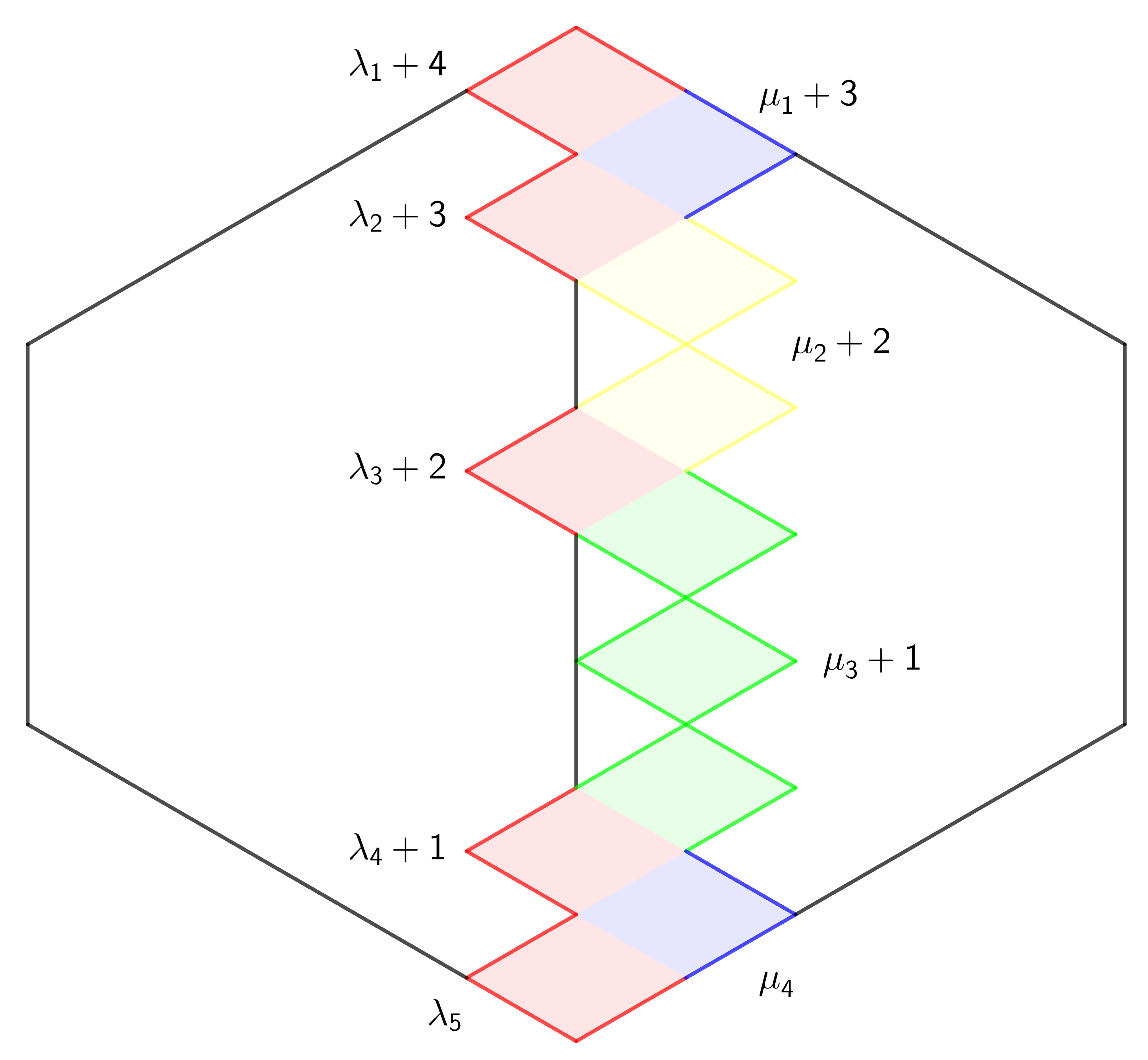
The Kenyon-Okounkov conjecture also postulates that the fluctuations of lozenge tilings should converge to the Gaussian free field as the scaling parameter increases to \(\infty\). This conjecture is verified for special cases in [10], [11], [12], [13], [4], and [5]; the method of Schur generating functions, which we discussed previously, is employed in [4] and [5] to analyze lozenge tilings.